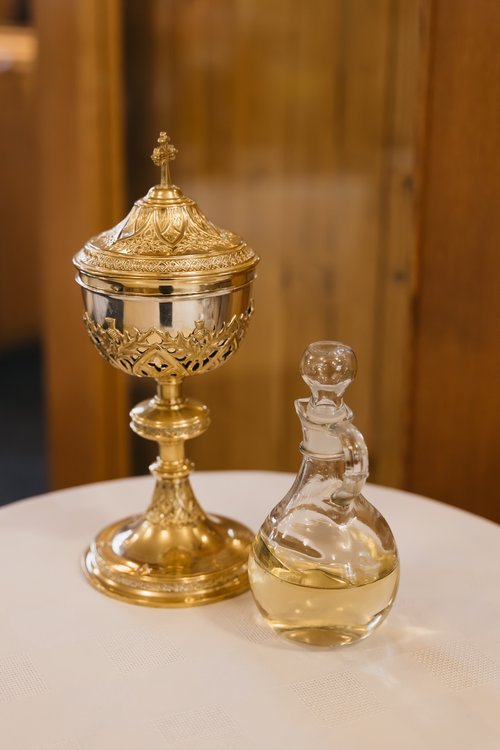
St. Augustine, in the 5th century, described a sacrament as 'an outward and visible sign of an inward and invisible grace...'

SACRAMENTS OF THE CATHOLIC CHURCH

BAPTISM

Congratulations on the birth of your child! A newborn in our midst can lead us to reflect more deeply on the mystery of God’s great love for us. As a parent, you are the first model of God’s love to your child and the first teacher to your child in the ways of Faith. May God bless you with wisdom, strength and grace as you live out your responsibilities as a Christian parent.

Baptism for Infants and Children

Baptism is the first Sacrament and the gateway to all the other Sacraments. Through it we become adopted children of God and members of his Body, the Church. Our Christian Faith tells us that in Baptism, we:

      • are reborn through water and the Holy Spirit as adopted children of God;
      • join Jesus in his death and resurrection as we pass through the water;
      • become members of the Church in which the Holy Spirit dwells and acts;
      • become disciples of the Lord Jesus;
      • are given the pledge of eternal life; and
      • are forgiven of sin and transformed into a new creation full of God’s grace.

Preparation for Baptism

When you are ready to have your child baptized, please complete the Baptism Registration Form and send it to the Parish office at least three (3) months in advance of your intended date to register your child for the Sacrament. The parents will then meet with the baptism coordinator to complete the registration form and ask any questions they have at this time. Parents are required to complete a Baptism Preparation course. The course consists of three sessions that take place over several months. Baptism Preparation courses are conducted several times during the year and all sessions are required. The course can be taken before the birth of your child.

The Parents’ Commitment

The celebration of Baptism is the first step in the making of a Christian. Following Baptism, your child begins the journey of Faith toward full membership in the Christian community by the eventual celebration of his/ her First Holy Communion and Confirmation. As a spiritual duty, parents are expected to nurture the faith life of their baptized child each step along the way and to bring them up practicing the faith, including regular Sunday attendance at Mass. This is the commitment parents make on their child’s baptismal day. Parents are also encouraged to become active in the parish by becoming involved in a ministry program.

      • Plans for a baptism? Let the Office know and, with your consent, we will pre-announce it on our website, Bulletin and/or our Weekly Update email for family and friends to celebrate with you and your infant! The Celebration of Baptism is normally conducted five or six times a year at Holy Name of Mary church. When scheduled, Baptisms are preformed during or after the 10:30 am Sunday Mass. 

For more information or to register your child for Baptism, please contact the Parish Office by email, or call 613-256-1034.

What Will Happen at the Baptism?

The following is a brief outline of the Baptism Rite when celebrated during Mass:

1. Reception of the Child. The parents and godparents are questioned about their intentions and the child is claimed for Christ.
2. Preparatory Rites. After a short prayer, the priest anoints the child with the Oil of Catechumens for spiritual strength.
3. Rite of Baptism. This includes the blessing of the water, the vows of renunciation, the profession of faith, the Baptism, an anointing with Sacred Chrism, the clothing with a white garment and the lighting and presentation of the baptismal candle.

When Baptism is celebrated outside of Mass, a Liturgy of the Word comprising of a proclamation of Sacred Scripture and the offering of intercessions occurs after the reception of the child. The celebration concludes with the recitation of the Lord’s Prayer, and special blessings on the parents before the final blessing and dismissal.

What About Godparents for My Child?

Godparents have a very special role in Baptism and in the faith journey of the child and the parents. Godparents help the parents so that the child will come to profess the Faith and live by the teachings of the Church. There are certain requirements to act as a godparent. Godparents need to be practicing Catholics in their parish. If the godparent does not belong to Holy Name of Mary Parish they will need to provide a letter of recommendation from their parish priest. Parents should inquire at the Parish Office regarding these requirements prior to asking any individual to assume this important spiritual role.

Baptism for Adults

If you are interested in receiving the Sacrament of Baptism for yourself, kindly see our Adult Faith Formation/ RCIA page, and use the contact form. We will be happy to assist you.

RECONCILIATION

Reconciliation and Relationship

Reconciliation is a Sacrament instituted by Jesus in his love and mercy to offer sinners forgiveness. At the same time, sinners are also reconciled with the Church because she is also wounded by our sins.

Every time we sin, we hurt God, other people and ourselves. In Reconciliation, we acknowledge our sins before God and his Church. We express our sorrow in a meaningful way, receive the forgiveness of Jesus, make reparation for what we have done and resolve to do better in the future.  Reconciliation involves four elements:

1. Contrition – a sincere sorrow for having sinned against God*;
2. Confession – confronting our sins in a profound way to God by speaking aloud of them to the priest, God’s minister;
3. Penance – a fundamental part of the healing process in which we are called to acts of good to reverse the harm done by our sin; and
4. Absolution – the priest speaks the words by which “God, the Father of Mercies” reconciles us to himself through the merits of the cross.

Preparing for Reconciliation

Confession Times: See the Bulletin or the Mass Times & Confession section for times when the Sacrament of Reconciliation is offered. The Sacrament of Reconciliation is also available by appointment. Please contact the Parish Office (613-256-1034) to schedule a time. Penitential Services with individual confession are held twice annually, during the seasons of Advent and Lent.

Act of Contrition: An Act of Contrition* expresses our sorrow for what we have done and commits us to improving our way of living and relationships. The Act of Contrition is said within the confessional before the priest gives a penance and absolution.

Memorize it or make it up? It is probably wiser to memorize an Act of Contrition, as above. If you then feel comfortable enough, you may want to use your own words, ensuring that your Act of Contrition includes all three of the following elements:

          • Step 1: True Sorrow for Sin
          • Step 2: Renunciation of Sin
          • Step 3: Firm Purpose  of Amendment

First Reconciliation for Adults

If you are interested in receiving the Sacrament of Reconciliation for yourself for the first time, kindly see our Adult Faith Formation/ RCIA page, and use the contact form. We will be happy to assist you.

FIRST EUCHARIST (Holy Communion)

You have asked to have your children baptized. In doing so you are accepting the responsibility of training them in the practice of the faith. It will be your duty to bring them up to keep God’s commandments as Christ taught us, by loving God and our neighbour. Do you clearly understand what you are undertaking?
Parents: We do.      ~ Rite of Baptism

Holy Name of Mary Parish offers a process to prepare baptized children, 7 to 10 years of age, for the Sacraments of First Reconciliation and First Eucharist. *If your child is not yet baptized, Please contact the Parish Office by phone (613-256-1034), or by email. The process for and the celebration of these sacraments is a family affair and involves both the parent and child. The most important component of the process is weekly attendance at Sunday Mass at Holy Name of Mary Parish.

Receiving the Sacrament      

Please read these documents: 

First Eucharist for Adults

If you are interested in receiving the Sacrament of First Holy Communion (Eucharist) for yourself, kindly see our Adult Faith Formation/ RCIA page, and use the contact form. We will be happy to assist you.

CONFIRMATION

The Sacrament of Confirmation is a significant step in the growth and development of every Catholic, necessary for the completion of baptismal grace. At Confirmation we affirm our commitment to God and the Church and receive a special outpouring of the Holy Spirit. The grace of this sacrament deepens our faith and brings us into a more abundant life with Christ, and strengthens us to share the love of Jesus Christ with others. It is by no means a “graduation” from practicing the faith, but rather just the beginning of a rich faith life!

Receiving the Sacrament      

Please read these documents:

Confirmation for Adults

If you are interested in receiving the Sacrament of Confirmation for yourself to walk in full communion with the Catholic Faith, kindly see our Adult Faith Formation/ RCIA page, and use the contact form. We will be happy to assist you.

MARRIAGE (Holy Matrimony)

Marriage is a vocation, a calling by God to live a particular way of life. As Catholic Christians, the love between a wife and husband is the sign of how God loves us and how Christ loves the Church. This is why Marriage is a Sacrament and the Church has surrounded it with special traditions and sacred rites.

Congratulations on your engagement and upcoming marriage!

Preparing for Your Big Day!

Your love is to be a sign of hope for us all. This is why it requires faith to take on this vocation before the whole world and faith to trust that God will be present in your married life together. As part of our commitment to assist you with the planning and preparation for your upcoming wedding, we offer you this information which will explain the main points of our Marriage Policy as well as answer most of your questions. We are here for you. Please contact the Parish Office by phone (613-256-1034), or by email for the most current and complete Marriage Policy.

Please read this document:  Getting Married at Holy Name of Mary, Almonte

      • Where do we get Married? Canon (Church) Law directs us that a marriage should take place in the parish of the bride or groom. Even though a young woman or man is living away from home, she or he can be married in the parish where their parents reside.  If a couple is getting married in a parish other than their own, the permission of your regular parish priest will be required for the wedding to take place in the other parish. When only one of the parties is Catholic, the marriage generally takes place in the parish of the Catholic party. 
      • Marriage between a Catholic and a Non-Catholic: The marriage of a Catholic to a non-Catholic requires that certain conditions be observed. There is no obligation that the non-Catholic party become Catholic. The Catholic party promises that she or he will do all in her or his power to have the children raised in the Catholic Faith, and that the marriage will be celebrated according to the form of the Catholic Church, that is, in the presence of a Catholic priest or deacon and two witnesses. 
        Normally a wedding between a Catholic and a non-Catholic takes place outside of Mass.
      • Scheduling the Wedding Date: Before a date can be reserved, the couple must first make an appointment with the parish priest. This should be done at least nine (9) months in advance of your intended date and before any other arrangements are made. If arrangements are made with the reception hall or caterers first, there is no guarantee that the Parish will be able to accommodate that date or time. Please contact the parish office as soon as you have chosen a date.
      • Interview with the Parish Priest: Before a date can be reserved for your wedding, the couple will need to meet with the parish priest for an interview. During this meeting, the priest will complete the prenuptial inquiry forms as well as provide you with a marriage folder to assist you in your preparation for the wedding liturgy. This is the time to ask any questions that you have regarding your proposed marriage. You will be required to have a Baptism certificate when you meet with the priest (see note below on Baptism Certificates).
      • Baptism Certificate: Every Catholic party must obtain a baptismal certificate from the parish where she or he was baptized. This certificate cannot be more than six (6) months old. You may bring the certificate with you or the parish of baptism may fax or mail a copy of the baptismal certificate to the Parish Office. A copy of the original baptismal certificate is required for a non-Catholic, Christian party and can be submitted to the Parish Office at any time. If the original cannot be found, the non-Catholic party will have to obtain a new baptismal certificate from the church where their baptism was celebrated.
      • Marriage Preparation Course: Since you are planning to spend the rest of your lives together, every step must be taken to ensure your happiness. To this end, the Church offers marriage preparation courses and you are required to take one prior to your marriage. Marriage preparation courses are offered regularly within the Archdiocese of Ottawa at various parishes. The parish office can supply you with the dates and locations of these courses.
      • Marriage License: At Holy Name of Mary Parish, couples are married by license, which is obtained at the Mississippi Mills Town Hall. The Province of Ontario website provides additional information regarding marriage licenses and banns.

Prayer and Practice of Faith

The time when couples are preparing for the Sacrament of Marriage can be a time of tremendous spiritual growth which can lead to renewed or deepened prayer and the practice of faith and worship. 

      • Prayer, both individually and together, is an important aid in the process of becoming a faithful married Catholic couple. Regular attendance at Sunday Mass, especially if you have been away from this practice for awhile, or are marrying a non-Catholic, will help ensure that your wedding is a true celebration of faith, life and love.
      • Simply put, the Sacrament of Marriage, like all Sacraments, needs faith to be fruitful. The practice of your faith will demonstrate that you are seriously preparing for this Sacrament and for your life together. The frequent reception of the Sacraments of Reconciliation and of the Eucharist during your engagement, lays a solid foundation of faith which will see you through the difficult moments that all marriages face, as well as deepen your times of joy together.

Planning the Wedding

You will plan your wedding liturgy with the assistance of the parish priest who will be officiating at your wedding. The couple is asked to not make any arrangements regarding musicians, decorations, flowers and photographers until first speaking with the parish priest.

      • Hours for Weddings: Weddings can take place on almost any weekday and on Saturday at 11:00 am and 1:30 pm. Weddings are never celebrated on Sundays.
      • Readings: The couple is asked to choose the readings and the readers for their wedding. The choice of readings can be discussed with the priest during your appointment. In order to help you in making these important choices, recommended readings can be found here.  You will need to select a First Reading, a Responsorial Psalm and a Second Reading.
      • Music: In selecting the music for your wedding, please remember that the ceremony is religious in nature, and thus the music must be sacred in character. Songs from movies, T.V. shows, or stage productions have no place in the Marriage liturgy. Favourite popular songs, meaningful to the bride and groom, are better suited to the wedding reception. Our Music Director can assist you in choosing hymns and helping you understand our policy on sourcing musicians from outside the Parish.  Please contact the parish office for more information and contact numbers.
      • Photography: The photographer is required to be present at the rehearsal in order to be aware of, and be accredited through, the Parish’s policy. Please make sure your Wedding Photographer is aware of these prerequisites in order to take pictures inside the church.
      • The Wedding Rehearsal: The rehearsal is normally held on the evening before the wedding. Everyone in the bridal party and those assisting in the ceremony must attend the rehearsal.
      • Punctuality: As a sign of courtesy to all, the couple and wedding party should be on time for the rehearsal and the wedding liturgy. It is neither fashionable nor polite for any member of the bridal party to arrive late. Keep in mind that there are other events and activities taking place in the church on the same day. Any delay of more than 15 minutes may result in a cancellation of the service.

HOLY ORDERS

Holy Orders is the Sacrament through which the mission entrusted by Christ to his apostles to proclaim the Good News continues to be exercised in the Church until the end of time. Holy Orders has three degrees, which are the episcopate (bishop), the presbyterate (priest), and the diaconate (deacon). Through the laying on of hands, men are ordained bishop or priest for roles of leadership in the Church or ordained deacon for the role of service in the Church.

The Sacrament of Mission at the Service of Unity

Priest, Prophet & King: At Baptism, we were all anointed with the Chrism of Salvation as priest, prophet and king. This mandate of our baptismal call is further emphasized at ordination. Once the candidate for Holy Orders is called forward the ”official” homily echoes these three offices of baptism:

      • “… you are to be raised to the Order of the Priesthood. For your part you will exercise the sacred duty of teaching in the name of Christ the Teacher … see that you believe what you read, that you teach what you believe, and that you practice what you teach … let what you teach be nourishment for the people of God.
      • “… you will exercise in Christ the office of sanctifying. For by your ministry the spiritual sacrifice of the faithful will be made perfect, being united to the sacrifice of Christ… Understand, therefore, what you do and imitate what you celebrate. … when you gather others into the people of God through Baptism … Penance; when you comfort the sick … when you offer prayers of praise … carry out the ministry of Christ the Priest with constant joy and genuine love, attending not to your own concerns but to those of Jesus Christ….
      • “… dear son, exercising for your part the office of Christ, Head and Shepherd, … strive to bring the faithful together into one family, so that you may lead them to God the Father through Christ in the Holy Spirit. Keep always before your eyes the example of the Good Shepherd who came not to be served but to serve, and who came to seek out and save what was lost.”

As clergy live out these offices in their daily lives, they probably never really think “am I being ‘priestly’ as I celebrate this baptism or am I being ‘prophetic’ as I speak to this group of students, or am I living out the ‘shepherding’ role as I sit here at a committee meeting.” Yet we are reminded by the Church’s instruction to the ordained that these offices of priest, prophet and king must be nurtured each day as this vocation is lived out in the ordinary moments of everyday life.

Formation for Holy Orders

In seminary, these three offices are nourished by the four areas of formation which are human, intellectual, pastoral and spiritual:

1. Human Formation aims to cultivate the humanity of priests so that they can be authentic men of the Gospel, communicating the message of Jesus Christ to those in their spiritual care.
2. Intellectual Formation aims to deepen the understanding of faith seeking to link theoretical knowledge with practical wisdom. It balances being pastor and theologian; it requires pastoral theology and theological reflection.
3. Pastoral Formation entails the development of skills that enable priests to serve their people well. These skills would include preaching and proclamation, presiding, counselling and communication skills. It is the practical side of theology.
4. Spiritual Formation aims to develop a lifelong desire to grow in the Christian life, striving each day to become better disciples of Jesus Christ.

Where to go from here?

If you feel that God is calling you to Holy Orders, continue to pray for guidance from the Holy Spirit and to speak to the parish priest or the Vocations Director at the Archdiocese of Ottawa-Cornwall.

For information on all vocations and how we are all called to serve the Lord, please visit the Vocations page..

ANOINTING OF THE SICK

Are any among you sick? They should call for the priests of the church and have them pray over them, anointing them with oil in the name of the Lord. The prayer of faith will save the sick, and the Lord will raise them up; and anyone who has committed sins will be forgiven. – James 5.14-15

Why celebrate this Sacrament?

Throughout our lives, and especially as we grow older, we may experience periods of poor health. When these moments are marked with a greater seriousness, the Sacrament of the Anointing of the Sick can offer both spiritual and physical healing.

In the Sacrament of the Anointing of the Sick, we encounter Jesus who heals and consoles us by offering us the presence of the Holy Spirit to strengthen us in body, mind and spirit during our time of illness. Our trust and faith in God are renewed and our suffering is united to Jesus’ suffering on the cross.

Who should receive this Sacrament?

  • The Sacrament of the Anointing of the Sick is for:
      • the elderly whose frailty is becoming more pronounced;
      • adults and children who are suffering from a major illness, are facing major surgery, or have suffered a serious accident; and
      • those who suffer from chronic illness or who suffer from a serious mental illness.

From this list, it is clear that the Anointing of the Sick is not meant to be celebrated before imminent death. Its proper celebration at the beginning and during illness and times of suffering and pain, recalls our hope in God’s promise to be with us always and provides us with the strength and consolation of the Holy Spirit to face our suffering with courage.

When is this Sacrament Celebrated?

When possible, the Anointing of the Sick is celebrated in the presence of family and friends.
The Anointing of the Sick may be celebrated more than once, usually at the beginning of the illness and when the illness intensifies. If the illness has persisted for a long time, do not wait until the final moments before death to contact the parish priest.

A request for the Anointing of the Sick can be made at any time by calling the Parish Office (613-256-1034), or if non-urgent, by emailing the Parish Office.

WHAT ARE THE SACRAMENTS?

The Catechism of the Catholic Church (CCC) defines sacraments as “efficacious signs of grace, instituted by Christ and entrusted to the Church, by which divine life is dispensed to us” (CCC 1131). 

      • A sacrament, therefore, is a sacred and visible sign that is instituted by Jesus to give us grace; grace being an unmerited gift from God. (See also CCC 1084).  The CCC explains that “the seven sacraments touch all the stages and all important moments of the Christian life”
      • It is fundamental to recognize that Jesus Christ was present at the inception of all of the sacraments he instituted 2,000 years ago.  He is present every time any sacrament is celebrated. In the Catholic faith, all of the seven sacraments instituted by Christ, are celebrated:
          1. Baptism: Foundational to the Christian faith, Baptism is rooted in Jesus’ own baptism (Matthew 3:16-17) and the Great Commission to baptize (Matthew 28:19).
          2. Confirmation: While not explicitly named as Confirmation, the outpouring of the Holy Spirit on the apostles at Pentecost (Acts 2:1-4) is seen as the fulfillment of Jesus’ promise and a confirmation of their faith.
          3. Eucharist: Instituted by Jesus at the Last Supper (Matthew 26:26-29), the Eucharist is the central sacrament of the Church, where bread and wine are consecrated as the body and blood of Christ.
          4. Reconciliation: Jesus’ ministry of forgiving sins and his post-resurrection bestowal of the Holy Spirit, including the authority to forgive sins (John 20:23), form the basis for this sacrament.,
          5. Anointing of the Sick: Found in James 5:14-15, where the elders are instructed to pray over the sick and anoint them with oil, this sacrament focuses on physical and spiritual healing.
          6. Holy Orders: The threefold division of sacred ministers (bishops, priests, and deacons) is prefigured in the Old Law and revealed in the New Testament (Acts 6:3-6; 1 Timothy 3:1, 8-9, 17-19); and
          7. Matrimony: Jesus refers to the indissolubility of marriage (Matthew 19:4-6), and St. Paul compares it to the mystery of Christ and the Church (Ephesians 5:31-32), according to Catholic scripture sources.

Consider then that the Sacraments have a visible and invisible reality open to all the human senses but grasped in their God-given depths through the eyes of faith.

      • The visible reality we see in the Sacraments is their outward expression, the form they take, and the way in which they are administered and received.
      • The invisible reality we cannot “see” is God’s grace, his gracious initiative in redeeming us through the death and Resurrection of his Son. His initiative is called grace because it is the free and loving gift by which he offers us a share in his life, and shows us his favor and his will for our salvation.

The saving words and deeds of Jesus Christ are the foundation of what he would communicate in the Sacraments through the ministers of the Church. Guided by the Holy Spirit, the Church recognizes the existence of the following Seven Sacraments instituted by the Lord. They are grouped as

      • Sacraments of Initiation
          • Baptism
          • Eucharist
          • Confirmation
      • Sacraments of Healing
          • Reconciliation /Penance
          • Anointing of the Sick
      • Sacraments at the Service of Communion
          • Marriage
          • Holy Orders

Through the Sacraments, God shares his holiness with us so that we, in turn, can make the world holier. (Adapted from USCCB.org)

Holy Name of Mary in 1875

Holy Name of Mary: Two Centuries Old

The local Catholic community dates to the 1820s. The stone church building was built in 1868-69 – our mission remains discipleship.  

Saints? So much to know and love

Saints hold a special place in a Catholic’s prayer life. They are not worshipped as idols, but venerated as channels for prayer to God. 

Funerals: Grieving, Care and Support

We believe there’s life after death, yet death of a loved one is a profound, sorrowful moment. Let us help you work through pain and process.

Issues with this page? Please email errors, omissions or changes to the Pastor